

Looking for the best AI tools for writers in 2026? I personally tested and ranked the top 10 — ChatGPT, Claude, Jasper, Surfer SEO and more. Find the right tool for your writing workflow today.
I have been working in digital marketing and website development for years. Content writing sits at the heart of everything I do — blog posts, landing pages, SEO articles, social media content and client campaigns.
When AI writing tools started becoming serious in 2023, I was genuinely skeptical. I had spent years building a writing process that worked. I did not want a robot ruining it.
But I tested them anyway. One by one. On real client projects. Real deadlines. Real content that had to actually rank on Google.
Top 10 Best AI Tools for Writers in 2026
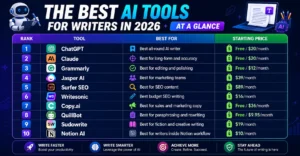
And here is what I found — the right AI tool does not replace your writing. It amplifies it. It removes the heavy lifting so you can focus on what actually matters — the original thinking, the personal experience, the genuine expertise that no AI can replicate.
This article is the result of real testing on real projects. Not theory. Not sponsored rankings. Just honest experience from someone who uses these tools daily to serve real clients.
Let me walk you through every tool that genuinely deserves your attention in 2026.
What Makes an AI Writing Tool Worth Using in 2026?
Before getting into the list, I want to set the right expectations.
The content market has not converged on pure AI generation despite early predictions that it would. What has emerged instead is a workflow model — use AI for the heavy structural lifting such as outlining, drafting, formatting and SEO optimization, and deploy human judgment for everything that actually matters — the original argument, the personal anecdote, the fact check, the edit that makes the piece actually good.
A rough ratio that keeps coming up in professional editorial conversations is 70% AI augmentation and 30% human soul. That is exactly how I use every tool on this list.
The best AI writing tools in 2026 share these qualities:
- Produce content that requires only light human editing
- Genuinely understand context and maintain a consistent tone
- Save significant time without sacrificing quality
- Integrate into a real writing workflow rather than replacing it
- Are honest about their limitations
With that said, let us get into the tools.
1. ChatGPT by OpenAI — Best All-Round AI Writer
Best for: Everyone — bloggers, marketers, freelancers, students, business owners
Pricing: Free tier available / ChatGPT Plus at $20/month
Website: chat.openai.com
If you could only pick one AI writing tool in 2026, this would be it for most people.
ChatGPT remains the most capable general-purpose writing AI in 2026. Powered by GPT-4, it handles everything from first drafts and brainstorming to tone adjustment, rewrites and translation. Where ChatGPT truly excels is versatility — it can write a product description, then pivot to a technical whitepaper, then draft a poem — all in the same conversation.
From my own experience working with clients across different industries, ChatGPT is the first tool I open every single morning. It handles briefs, outlines, first drafts, email copy, social media captions and content ideation faster than any other tool I have used.
What I personally love about it:
The free tier is genuinely powerful. The GPT-4o mini model handles most everyday writing tasks without any payment. And ChatGPT Plus at $20/month unlocks the full model for longer and more nuanced content that actually competes with premium tools costing 3 to 5 times more.
Where it falls short:
Without strong prompting, it can produce generic content that sounds like every other AI-generated article on the internet. Your prompting skills directly determine the quality of output. Also, no built-in SEO tools or team collaboration features — it is a raw model, not a content platform.
My honest verdict:
If you are still staring at a blinking cursor on a blank page in 2026, you are working too hard. ChatGPT removes that blank page problem entirely. For any writer — beginner or experienced — this is the non-negotiable starting point.
Best use cases: Blog outlines, first drafts, email copy, social captions, brainstorming, research summaries, ad copy variations
2. Claude by Anthropic — Best for Long-Form Writing and Accuracy
Best for: Long-form writers, researchers, essayists, content strategists
Pricing: Free tier available / Claude Pro at $20/month
Website: claude.ai
If ChatGPT is the most versatile tool, Claude is the most thoughtful one.
Claude is the best choice for long-form writing and accuracy — superior structure, accuracy and instruction following make it stand out for writers who need nuanced, well-reasoned content.
I use Claude specifically when a piece of content requires depth, nuance and careful reasoning. For articles over 2000 words, detailed research pieces, and sensitive topics that require balanced perspectives, Claude consistently outperforms everything else I have tried.
The real workflow most professionals use is stacked — draft in Claude or ChatGPT, pull research in Perplexity when accuracy matters, run SEO shaping in Surfer, finish with Grammarly if you need polish.
What I personally love about it:
Claude has an enormous context window — meaning it can handle extremely long documents, maintain consistency across lengthy pieces and remember detailed instructions throughout an entire conversation. For any writer working on long-form content, this is a genuine game-changer.
Where it falls short:
Like ChatGPT, it has no built-in SEO tools, no workflow features and no team collaboration. It is a writing partner, not a content platform. You need to pair it with other tools for a complete workflow.
My honest verdict:
For deep long-form thinkers, Claude Pro at $20/month is the most human-sounding AI available — perfect for massive documents and nuanced essays. For bloggers and content writers who care deeply about quality over speed, Claude is often the better choice over ChatGPT.
Best use cases: Long-form articles, research pieces, detailed reports, book chapters, in-depth guides, and content that requires careful reasoning and a balanced perspective
3. Grammarly — Best for Editing, Polishing and Professional Writing
Best for: Every writer who wants to publish polished professional content.
Pricing: Free tier available / Grammarly Pro at $12/month
Website: grammarly.com
Every writer on this list needs Grammarly. No exceptions.
Grammarly occupies a unique position — it sits alongside your existing workflow rather than replacing it. Available in Gmail, Google Docs, Word, Slack and every major browser, it catches grammar errors, flags unclear sentences and suggests style improvements in real time.
I have been using Grammarly for years across every piece of content I produce — whether AI-assisted or written entirely from scratch. It catches the mistakes that spell checkers completely miss. Awkward phrasing. Passive voice overuse. Unclear sentences. Inconsistent tone. All of it flagged instantly.
Grammarly has reinvented itself for 2026. With 30 million daily active users, it was already the dominant text correction tool. Its new Authorship feature tracks your actual keystrokes and typing patterns to produce a record proving your work was human-generated — increasingly important for freelancers submitting to clients with AI detection policies.
It works everywhere. Gmail. Google Docs. Microsoft Word. WordPress. LinkedIn. Slack. Any browser. You never have to copy and paste your content into a separate tool. Grammarly sits invisibly in the background and catches errors in real time wherever you are writing.
Where it falls short:
It is not designed to generate long-form content from scratch. The generative AI features are useful for rewrites and short content but it is fundamentally an editing and polishing layer — not a content creation engine.
My honest verdict:
A solo marketer can get 80% of the value from ChatGPT Plus at $20 per month or Claude Pro at $20 per month plus Grammarly. Only upgrade to specialized tools like Jasper or Surfer when you have consistent, specific needs they address. Grammarly is the mandatory final step for any writing workflow — AI assisted or otherwise.
Best use cases: Grammar and style checking, tone adjustment, clarity improvement, rewriting awkward sentences, professional email polishing, AI content editing
4. Jasper AI — Best for Marketing Teams and Brand Consistency
Best for: Marketing teams, content agencies, brands needing consistent voice at scale
Pricing: Creator at $39/month (annual) / Pro at $59/month (annual)
Website: jasper.ai
Jasper is where AI writing gets serious for marketing teams.
Jasper’s Brand Voice feature is genuinely impressive. It reads your existing content, infers your tone and style and then maintains that consistency across everything it generates. Over 50 templates cover the standard marketing content types. The Kanban-style campaign manager is a genuine productivity gain for teams.
I have recommended Jasper to several of my larger clients who manage content teams of 5 or more writers. The brand voice training alone is worth the price — it eliminates the back and forth of constantly reminding team members and AI tools about tone, terminology and style guidelines.
What I personally love about it:
The Surfer SEO integration built directly into the Jasper editor is a genuinely powerful combination. You write inside Jasper and Surfer’s content score updates in real time as you add recommended keywords and terms. For teams producing SEO content at scale this saves hours of back and forth between separate tools.
Where it falls short:
For the majority of individuals and small teams evaluating AI marketing tools, if you are comfortable configuring your own AI workflow ChatGPT or Claude at $20 per month gives you equivalent output quality with more flexibility. Jasper earns its premium for teams that need brand governance without technical overhead.
Jasper has no free tier — just a 7-day trial. And at $39 to $59 per month, it is significantly more expensive than ChatGPT or Claude for what is ultimately a GPT-powered tool with a marketing layer on top.
My honest verdict:
For a solo writer or small team, ChatGPT plus Grammarly beats Jasper on both price and flexibility. For a content team of 5 or more people with strict brand guidelines and high volume output requirements — Jasper’s investment is genuinely justified.
Best use cases: Brand consistent marketing copy, campaign management, team content workflows, social media at scale, ad copy variations, enterprise content production
5. Surfer SEO — Best for SEO Content That Actually Ranks
Best for: SEO professionals, content marketers, bloggers focused on organic search
Pricing: From $89/month
Website: surferseo.com
If ranking on Google is your primary goal, Surfer SEO is not optional. It is infrastructure.
Surfer remains the gold standard for on-page SEO writing support. In 2026, its most important evolution is its move toward Answer Engine Optimization — AEO. It now helps structure content to appear in AI-generated search overviews, not just traditional Google results. For any team whose traffic depends on organic search Surfer is not optional — it is infrastructure.
I have used Surfer SEO on client projects where organic ranking was the primary KPI. The difference in results between content optimised through Surfer versus content written without it is significant and measurable. It analyses the top ranking pages for your target keyword and gives you a real time score as you write — telling you exactly which terms to include, how to structure headings and what word count to target.
What I personally love about it:
The Content Editor is where Surfer earns its price. It shows you exactly what topics, keywords and questions the top ranking articles cover — and scores your content in real time as you write. It removes the guesswork from SEO content completely.
Where it falls short:
It is expensive — starting at $89 per month. For individual bloggers or small operations, this is a significant investment. Also it tells you what is already ranking — meaning content built purely around Surfer recommendations can feel derivative. You still need to inject original thinking, personal experience and genuine expertise to stand out.
My honest verdict:
If ranking matters, use a writing model plus an SEO layer. Surfer is more valuable as an optimization system than as a standalone raw writer. My recommended workflow — draft in Claude or ChatGPT, then optimize in Surfer. That combination produces content that is both genuinely good and search optimized.
Best use cases: SEO blog posts, pillar content, content audits, keyword-optimized landing pages, competitive content analysis, Answer Engine Optimization for AI search
6. Writesonic — Best Budget Option for SEO Content at Volume
Best for: Freelancers, bloggers, small businesses needing SEO content affordably
Pricing: Free tier / Paid plans from $16/month
Website: writesonic.com
Writesonic does what Surfer SEO does — at a fraction of the price.
Writesonic is best for SEO blog volume — solid output at a reasonable price point for content marketers producing SEO articles at scale.
For clients who need consistent SEO content output but cannot justify the $89 per month Surfer price tag, Writesonic is my recommended alternative. It has built-in SEO optimization tools, an AI article writer and a Chatsonic feature that works similarly to ChatGPT.
What I personally love about it:
Starting at just $16 per month, Writesonic provides a massive amount of specialized features for the price of a Netflix subscription. For budget-conscious writers who need SEO focused output consistently, the value is genuinely impressive.
Where it falls short:
Output quality is below ChatGPT and Claude for complex topics with occasional repetitive phrasing and some features feeling template-heavy. Content built around what is already ranking can feel derivative. You need to inject original thinking to make it genuinely stand out from competitors.
My honest verdict:
If your budget is tight and you need SEO focused content regularly, Writesonic at $16 per month is a smart choice. If budget is less of a concern and quality is the priority, Claude or ChatGPT plus Surfer SEO will produce superior results.
Best use cases: SEO blog posts at scale, affiliate content, niche site articles, keyword-optimized first drafts, budget content marketing
7. Copy.ai — Best for Sales Copy and Marketing Automation
Best for: Sales teams, marketers, email copywriters, ad copy creators
Pricing: Free tier / Paid plans from $36/month
Website: copy.ai
Copy.ai has evolved significantly in 2026 — moving beyond simple copy generation into full sales and marketing workflow automation.
Copy.ai is one of the cleanest specialist picks for email copy workflows. Claude is better if you want more nuanced less templated messaging. ChatGPT is the easiest general fallback for quick campaign drafts.
I use Copy.ai specifically when a client needs large volumes of sales emails, ad variations, product descriptions or marketing copy generated quickly. The workflow builder is genuinely impressive for teams that need to automate repetitive copy tasks.
What I personally love about it:
The template library covers virtually every sales and marketing copy format imaginable. Cold emails, follow-up sequences, LinkedIn messages, Facebook ads, Google ad copy, product descriptions, landing page headlines — all with a single click starting point that you refine from there.
Where it falls short:
For nuanced long-form writing, Copy.ai is not the best choice. It shines for short form, high volume, structured marketing copy — not for thoughtful essays, detailed guides or content that requires genuine depth and original thinking.
My honest verdict:
If you are a marketer or sales professional who needs consistent copy output at speed, Copy.ai is worth the investment. For general writing needs, ChatGPT or Claude will serve you better at a lower price.
Best use cases: Cold email sequences, ad copy, product descriptions, social media captions, marketing campaign copy, sales automation workflows
8. QuillBot — Best for Paraphrasing, Rewriting and ESL Writers
Best for: Students, ESL writers, content teams repurposing existing articles
Pricing: Free tier / QuillBot Premium at $9.95/month
Website: quillbot.com
QuillBot solves a very specific problem — and it solves it better than anything else available.
QuillBot specializes in transforming existing text rather than generating content from scratch. Its paraphrasing engine offers multiple modes — Standard, Fluency, Formal, Creative and more — letting you reshape sentences while preserving meaning. The platform also includes grammar checking, summarisation and a citation generator. QuillBot is the go-to tool for students writing essays, ESL learners improving their English and content teams repurposing existing articles for new channels.
I recommend QuillBot specifically to clients who have existing content that needs refreshing, repurposing or simplifying for different audiences. It is also my recommendation for any non-native English writer who wants to improve the natural flow and clarity of their writing without losing their original meaning.
What I personally love about it:
At $9.95 per month, QuillBot Premium is one of the most affordable, genuinely useful writing tools available. The paraphrasing modes give you real control over how dramatically you want to rewrite a passage — from subtle refinements to complete rewrites in a different tone.
Where it falls short:
It is not a content generation tool. If you need to create content from scratch, QuillBot is not the right starting point. It works on existing text, not blank pages.
My honest verdict:
Grammarly wins for real-time grammar and style in email, Google Docs and Word. QuillBot wins for paraphrasing at the sentence level with multiple tone modes. QuillBot Premium at $9.95 per month is cheaper and stronger on paraphrasing.
Best use cases: Paraphrasing existing content, simplifying complex text, repurposing articles for different audiences, ESL writing improvement, summarisation, and academic rewriting
9. Sudowrite — Best for Fiction Writers and Creative Writing
Best for: Fiction authors, novelists, screenwriters, creative writers
Pricing: From $19/month (Hobby) / $29/month (Professional)
Website: sudowrite.com
Every tool on this list up to this point is primarily built for non-fiction, marketing or business writing. Sudowrite is the exception — and for fiction writers, it is genuinely in a category of its own.
Sudowrite is designed for creative writers. It was designed for fiction authors and creative writers — think of it as an AI writing partner that helps you brainstorm ideas, push through writer’s block and add some extra flair to your stories. It has a Story Bible to keep track of your characters and plot points, a Describe button that adds rich sensory details to a scene and a Write feature that can continue your story in your own voice.
Sudowrite is one of the most popular AI fiction writing tools, and its custom-trained Muse model is the headline feature. Muse is fine-tuned specifically on published fiction with author consent and produces polished prose out of the box — strong on dialogue cadence, sensory detail and genre conventions.
What I personally love about it:
The editing tools are where Sudowrite truly earns repeat users. Describing adds sensory detail to a passage. Rewrite transforms tone, style or perspective. Expand develops a sketch into full prose. These work on text you have already written — making Sudowrite genuinely useful for revision and not just generation.
Where it falls short:
Sudowrite is not designed for business or marketing content like SEO articles or sales emails. It is a pure creative writing tool — take it outside that context and it quickly becomes the wrong choice.
My honest verdict:
According to the 2025 Author Guild survey, 45% of published fiction writers now use AI tools in some part of their creative process — primarily for brainstorming, overcoming writer’s block and developing characters. If you are a fiction writer, Sudowrite is the most purpose-built and genuinely useful tool in this space.
Best use cases: Novel writing, short story development, character and plot brainstorming, scene expansion, dialogue refinement, overcoming writer’s block, creative prose polishing
10. Notion AI — Best for Writers Already Inside the Notion Ecosystem
Best for: Writers, teams and creators who already use Notion for organization
Pricing: $10/month add-on to existing Notion plan
Website: notion.so
If you already live inside Notion for notes, research, project management and content planning — Notion AI is the most seamlessly integrated writing assistant you can add to your workflow.
Notion AI sits directly inside your existing Notion workspace. No switching tabs. No copying and pasting between tools. Your AI writing assistant lives in the same space as your notes, outlines, content calendars and research documents.
What I personally love about it:
The workflow integration is genuinely unmatched for Notion users. Draft a blog post outline in your content calendar, have Notion AI expand it into a first draft, then move it directly to your publishing workflow — all without ever leaving the platform. For organized writers who use Notion as their central hub, this is an enormous time saver.
Where it falls short:
If you do not already use Notion, this is not the tool to start with. The AI capabilities are good but not exceptional compared to Claude or ChatGPT. The value comes entirely from the workflow integration, not from superior AI writing quality.
My honest verdict:
Notion AI works well if your team already lives in Notion. If you do not use Notion currently, start with ChatGPT or Claude instead. But if Notion is already your writing and organization hub, the $10 per month AI add-on is one of the best value upgrades available.
Best use cases: Content planning and drafting inside Notion, meeting notes to content, research organization, team content workflows, internal documentation writing
The Best AI Writing Tool Stack for 2026 in my Opinion
After testing all of these tools on real client projects, here is the exact setup I recommend based on different situations:
For solo writers and bloggers on a budget: ChatGPT (Free or $20/month) + Grammarly (Free or $12/month). Total cost: Free to $32/month. Covers 80% of everything most writers need.
For SEO focused content creators: Claude ($20/month) + Surfer SEO ($89/month) + Grammarly ($12/month). Total cost: $121/month. The most powerful combination for content that ranks.
For marketing teams: Jasper AI ($59/month) + Surfer SEO ($89/month) + Grammarly ($12/month). Total cost: $160/month. Brand consistent, SEO optimized, team ready.
For fiction writers: Claude ($20/month) + Sudowrite ($19/month) Total cost: $39/month. The combination of the most productive fiction authors in 2026 is being used.
For budget-conscious beginners: ChatGPT Free + Grammarly Free + QuillBot Free Total cost: $0. Genuinely capable stack for anyone just starting.
The Most Important Thing I Want You to Remember
AI writing tools are not a replacement for your voice, your experience or your expertise.
I have been in digital marketing long enough to see what happens when people use AI as a shortcut rather than a tool. Content that ranks short-term but has zero genuine value. Articles that read like they were written by nobody because they were written by nobody. Websites that get traffic but convert nothing because there is no real human behind the words.
The writers who win in 2026 are not the ones who use AI the most. They are the ones who use AI smartly — to handle the structural heavy lifting while their genuine knowledge, real experience and authentic voice shape the final product.
Use these tools to write faster. Use them to overcome writer’s block. Use them to optimize for search. But never use them to replace the one thing that makes your writing worth reading — you.
FAQs
- Which AI tool is best for beginners in 2026?
ChatGPT on the free tier is the best starting point for any beginner. It is versatile, powerful and completely free to start with.
- Can AI-written content rank on Google in 2026?
Google says they evaluate content quality, not how it was made. Well-edited AI content ranks fine. Unedited AI output with obvious errors gets ignored. The editing matters.
- Do I need multiple AI writing tools?
Most successful content teams use 2 to 3 tools — a general-purpose AI writer like ChatGPT or Claude, a specialized tool for their main use case like SEO or ads, and Grammarly for editing.
- What is the best free AI writing tool in 2026?
ChatGPT, with its free tier offering GPT-4o mini, and Claude, with its free tier, are the strongest free options for generating content from scratch. For most individuals, ChatGPT Plus at $20 per month does everything Jasper does for long-form writing. Jasper’s value today lives in its Brand Voice training, team workflows and Marketing Lab templates — features that matter to mid-market marketing teams but are overkill for solo creators.
If you are looking to build a brand or start a new business, and you are looking for any of these services for your business, such as Digital Marketing(SEO, Social Media Marketing, Google Ads and Meta Ads). Feel free to reach out to us; we are really happy to start a journey with you with our expertise.